
What We Learned at Future of Energy Conference 2026
1 September 2026 · Clean Energy
Read10 July 2026 · 5 min read
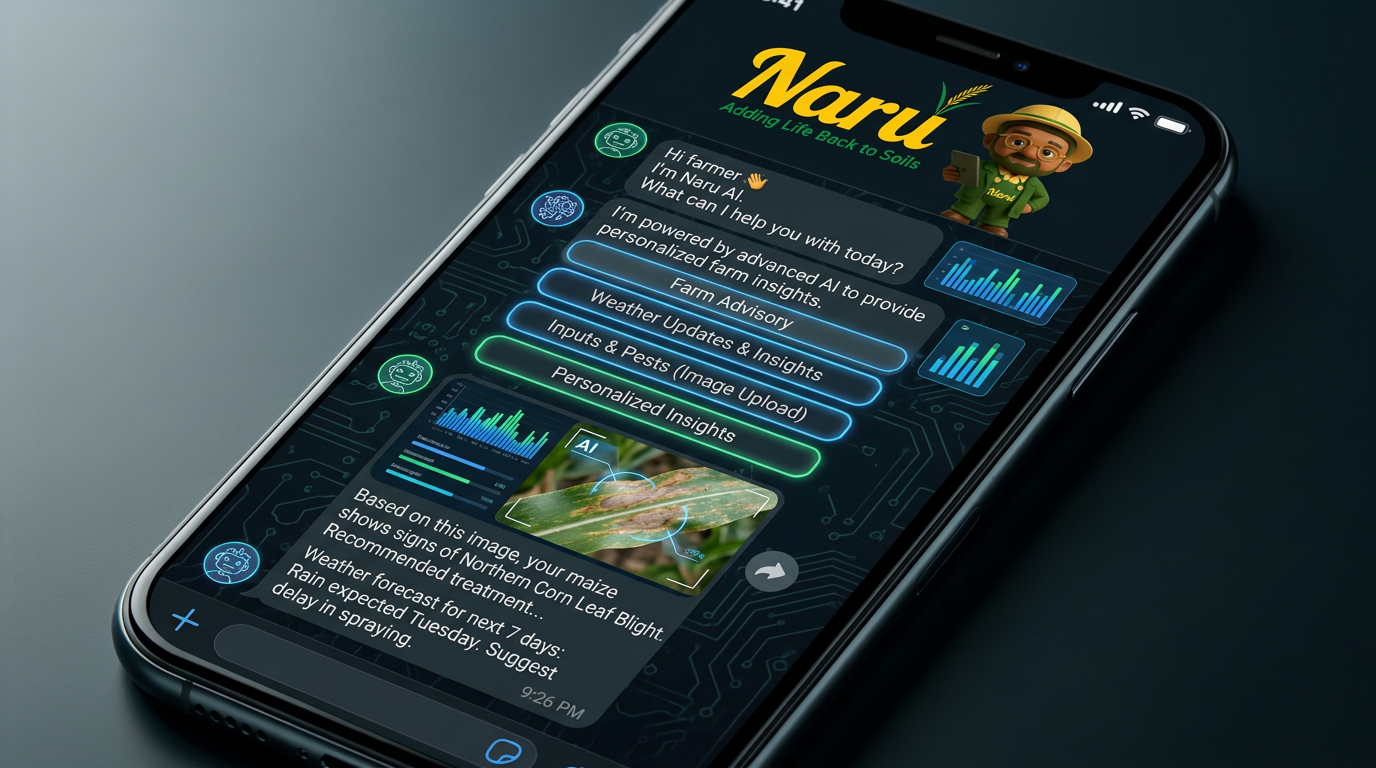
A forecast that says “60% chance of rain” does not tell a farmer whether today is the day to spray, dry harvested grain, prepare land, or wait for a better planting window. What matters is what the weather means for the work in front of them. That is the problem we designed Naru’s weather service to solve: turning a forecast into a farm decision, directly on WhatsApp.
How does Naru turn a forecast into something useful?
Naru is Sustainology’s artificial intelligence (AI) agricultural assistant for smallholder farmers in Ghana. Farmers access it through WhatsApp, without downloading another app or creating a separate account. They can interact through text, voice notes, or photos.
For weather updates, the process is simple. A farmer opens Naru, taps Weather Alerts, and shares their farm’s location using WhatsApp’s location pin. Naru uses those exact coordinates to retrieve the local forecast and returns it as a short WhatsApp message.
The farmer does not need to type the name of a town or interpret a technical weather table. The location comes from the field itself.
The forecast is organised around four useful horizons: today, tomorrow, in three days and in seven days. Each gives the farmer a quick view of temperature, general conditions and relevant rain or storm windows.
Why remove the percentages from a weather forecast?
Naru deliberately does not present rain probabilities. Instead, it translates rainfall data into timing and intensity.
A farmer sees information such as “Light rain from 2:00 PM–5:00 PM” rather than a percentage that still needs interpretation. The system identifies wet periods, joins nearby rain spells into a single window and separates daytime and nighttime rainfall.
This distinction matters because farming decisions are time-sensitive. A rain window can help a farmer think about when to work in the field, when to dry produce or whether a planned activity needs to move.
Naru also uses words for rainfall intensity and temperature rather than asking the farmer to interpret raw measurements. If storm conditions appear during working hours, the weather summary gives that information priority.
That is the translation layer. Raw meteorological data becomes a message designed around a farming decision.
Is the weather forecast itself generated by AI?
No. We made a deliberate decision not to use generative AI for the weather numbers or their interpretation.
The system takes the farmer’s location, retrieves hourly forecast data, and passes that data through a deterministic rule engine. The same weather data produces the same forecast wording every time.
This is an important part of how we approach AI in agricultural advisory. We use AI where it adds value, such as understanding farmer questions and working with agronomic knowledge. Where a calculation needs to remain predictable, we keep the calculation outside the language model.
For weather, the machine does not need to be creative. It needs to be consistent.
Why put an agricultural weather advisory on WhatsApp?
A separate agricultural app creates a new destination for the farmer. Naru instead works inside a communication tool that many farmers already know how to use.
There is no app-store search, additional login or new interface to learn. The weather flow itself requires no typing: the farmer taps the menu, selects Weather Alerts and shares a location pin.
Naru also supports voice interaction. A farmer can send a voice note, receive an answer and continue the conversation through voice. The weather flow remains particularly simple because location and menu buttons do most of the work.
This does not mean Naru currently reaches feature-phone users. WhatsApp requires a smartphone and data connection. Our approach is to reduce the barriers for farmers who already have access to WhatsApp, rather than asking them to adopt another digital platform.
How does weather connect to the rest of farm advisory?
Weather is not useful in isolation. It becomes more valuable when it sits alongside the other information a farmer needs to make a decision.
That is why Naru connects its weather service with other advisory routes. A farmer can use the same assistant to access the plant clinic, soil-testing service and structured guidance on areas such as land preparation, farm inputs, nursery management, weed control, pest help and post-harvest activities.
For example, a farmer can send a photo of a sick plant through the plant clinic. The system uses a crop-disease classification model alongside a general vision model, with the diagnosis gated by a confidence threshold. Weather context can then become part of the wider conversation around what the farmer should consider doing next. This makes the chatbot less like a collection of disconnected tools and more like a single entry point into agricultural advisory.
What does Naru refuse to do?
The most important features of Naru are the things it refuses to do.
Its core rule is simple: if information is not known or insufficient, ask. Do not invent. For advisory questions, Naru must retrieve information from a curated, expert-validated agronomic knowledge base before giving an answer.
It also does not invent dosages. If safety-relevant information is missing, the system asks for clarification rather than guessing. Different types of questions receive different levels of control, with higher-risk advisory and transactional requests routed through stricter processes.
The same principle applies to services. Naru will not simulate a soil-test result, promise a service that has not been delivered or manufacture an answer simply to keep the conversation moving. When uncertainty matters, the system is designed to disclose it and direct the farmer towards expert support. It is built for farming-related questions rather than general conversation. That narrow scope is intentional.
For us, responsible climate-smart agriculture digital advisory is not about putting an AI label on a weather service. It is about deciding where AI belongs, where it does not, and what happens when the system does not have enough information to answer safely.
What should farmers and agricultural organisations expect next?
We are building Naru around a simple principle: digital agricultural advice should fit into the farmer’s existing workflow rather than asking the farmer to build a new one.
The next step is to keep improving the connection between weather, crop information, soil data and agronomic guidance while expanding access through voice and local-language capabilities.
For farmers, the immediate action is simple: use the Weather Alerts route, share the location of the farm and treat the forecast as an input into the day’s planning.
For organisations working with smallholder farmers, the opportunity is to look beyond the forecast itself. The useful question is not only “What will the weather be?” but “Can the farmer turn that information into a better decision?”
Keep reading
1 September 2026 · Clean Energy
Read
10 August 2026 · Clean Energy
Read
5 August 2026 · Carbon Removal
Read