What We Learned at Future of Energy Conference 2026
1 September 2026 · Clean Energy
Read5 August 2026 · 8 min read
Carbon removal is often discussed in terms of how many tonnes can be removed. For us, the harder question comes first:
Can you prove what happened to the carbon?
That question sits at the centre of our Black Gold Biochar Initiative in Ghana.
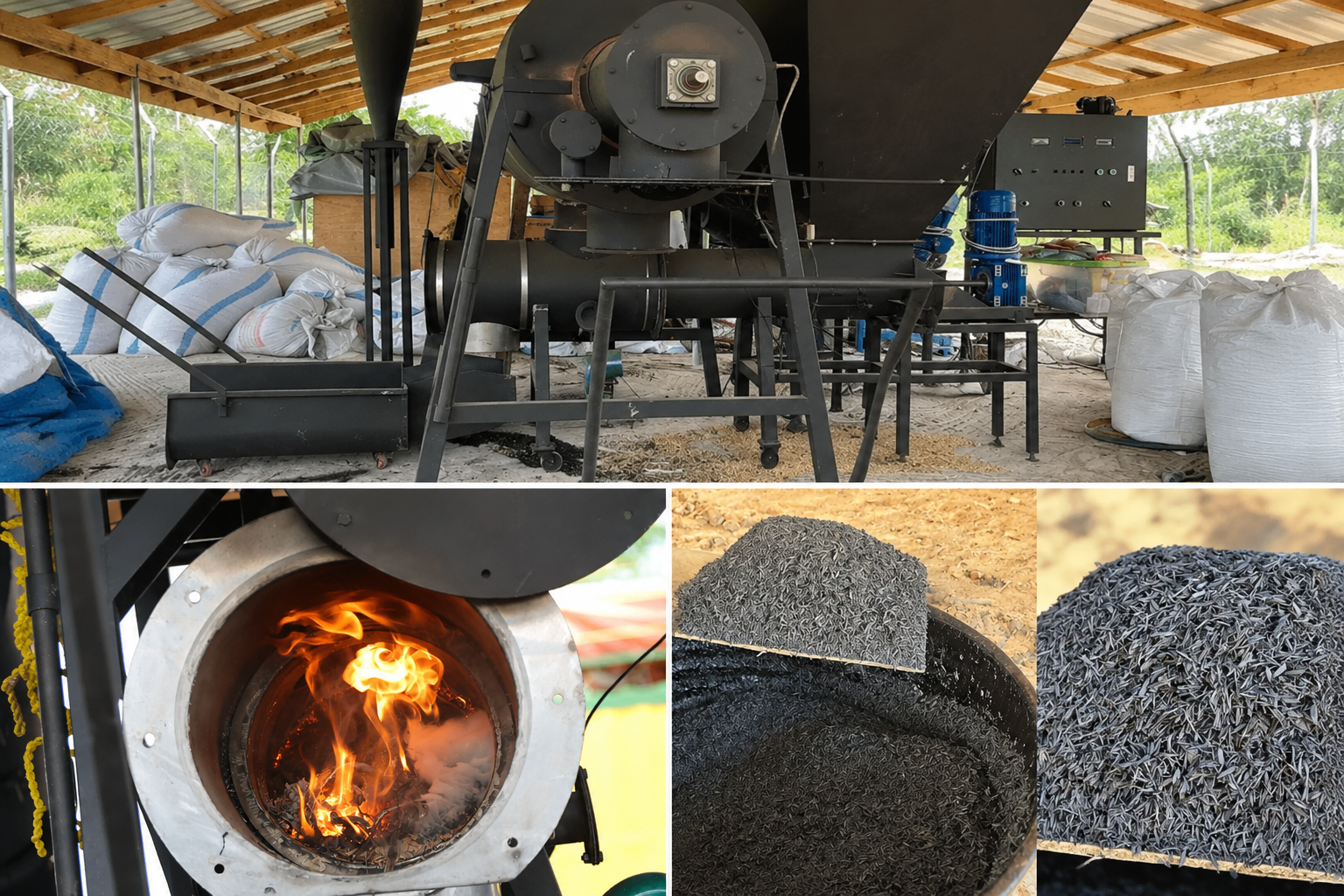
We are developing the project around a pyrolysis unit, agricultural residues, digital monitoring and a defined carbon-accounting framework. The physical process is straightforward. Agricultural waste enters the unit, is converted into biochar through pyrolysis, and the resulting material is returned to agricultural soils.
The difficult part is documenting that chain accurately, production run after production run.
That is why we built digital monitoring into the operation itself rather than treating it as a reporting layer added later.
Why is biochar a durable carbon removal pathway?
Most carbon removal approaches begin with the same problem: carbon dioxide has to be removed from the atmosphere and kept out of it for a meaningful period.
Biochar offers one of the more established pathways for doing this with biomass.
Plants absorb carbon dioxide as they grow. Agricultural residues therefore contain carbon that would otherwise return to the atmosphere through decomposition or open burning. Pyrolysis heats that biomass in a low-oxygen environment and converts part of the carbon into a stable, carbon-rich solid.
That solid is biochar.
Biochar is not automatically permanent. Its durability depends on the feedstock, production conditions and properties of the resulting material. Different biochars behave differently.
But under the right production and storage conditions, biochar can keep a significant share of its carbon stored for hundreds of years or longer. That makes it one of the relatively few carbon removal pathways available today that can connect atmospheric carbon removal with a physical material that can be produced, tracked and stored.
For a carbon removal project, however, producing biochar is only the beginning.
The claim has to follow the material.
The Black Gold workflow: feedstock to soil
Our operating chain has four connected stages:
Feedstock → pyrolysis → biochar → soil application
The first stage is feedstock.
Our Ghana operation uses agricultural residues like rice husks, as the biomass entering the unit. The quantity and characteristics of the incoming material matter because the carbon accounting begins with what actually enters the production system.
The second stage is pyrolysis.
The unit converts the biomass under controlled thermal conditions, producing biochar alongside other outputs from the process. Production conditions matter because they influence the properties of the resulting biochar and therefore the basis for its carbon-storage claim.
The third stage is the resulting biochar.
This is where physical production has to become a traceable record. We need to know how much material was produced, which production run it came from and how it relates to the feedstock that entered the unit.
The final stage is application.
The biochar is intended for use in agricultural soils. This connects the carbon-removal activity with regenerative agriculture practices, resulting in healthier soils.
So the process is not simply about turning waste into a black material.
It is about creating a documented chain from agricultural residue to durable carbon storage and then returning that carbon-rich material to the farm.
What does digital monitoring actually record?
A carbon removal project cannot rely on a monthly figure saying that a certain amount of biochar was produced.
A verifier or buyer needs to understand where that figure came from.
Our digital MRV system is designed around the production run.
At the feedstock stage, the system records what material enters the unit. During production, it captures operational information such as temperature and production data. Moisture measurements are also collected according to the quantity of feedstock being processed.
The system requires defined photographic evidence alongside the operational data.
The photographs are not simply stored in a gallery. Each has a purpose. They can document things such as feedstock weight, the production equipment, biochar samples and control-box readings.
Temperature readings are also assigned to specific points in the production run. This means a reviewer can distinguish between a reading taken early in production, one taken during the run, and one taken before the run ends.
The system also connects these records to the relevant production batch.
That matters because a photograph or temperature reading has limited value on its own. Its value comes from knowing which production event it belongs to.
Why buyers and registries care about this?
Carbon removal is not the same as reporting that an environmental activity took place.
A removal claim needs evidence that the carbon was actually stored, that the storage meets the required durability criteria, and that relevant emissions and counterfactual outcomes have been accounted for.
That creates an evidence chain:
Feedstock → production conditions → biochar output → storage/application → carbon calculation
If the feedstock record is missing, the starting point of the calculation becomes uncertain.
If production data is incomplete, it becomes harder to establish how the material was produced.
If output records do not reconcile with inputs, there is a mass-balance problem.
And if the final biochar cannot be connected to its storage or application destination, the chain ends before the claimed storage event.
This is why buyers and registries care about the underlying records rather than only the final removal number.
The number needs evidence behind it.
Validation has to happen at the point of capture
One of the biggest lessons from building the system is that validation cannot live at the end of the process.
If an operator leaves the site and a required photograph is found to be missing days later, that photograph usually cannot be recreated.
The production run has already happened.
So the platform places evidence requirements inside the workflow.
A run cannot progress without the required records. The system requires eleven defined photographs, temperature readings, and moisture measurements scaled to feedstock quantity.
This turns completeness into a product rule.
A batch reaching review is not simply a batch that an operator remembered to submit. It is a batch that has passed the required evidence gates.
That distinction matters when the system is used repeatedly at an operating production site.
The evidence has to remain connected
We also designed the system to reduce the number of decisions an operator has to make about where a record belongs.
The platform resolves the relevant production batch using the unit, feedstock type, feedstock source and time window.
This reduces the risk of an operator attaching evidence to the wrong production run.
The same principle applies to physical material.
Our finished product follows a fixed recipe of biochar and compost per bag. Bag identifiers also retain their lineage. A physical bag can be traced back to its production unit, batch, run and sequence.
The objective is simple: the digital record should continue to describe the physical material as it moves through the system.
The system has to preserve history, not just status
A current database status only tells you where something is now.
It does not necessarily tell you how it got there.
That is why every bag state change creates an inventory movement record, while significant changes to records create audit entries identifying the actor, action and entity involved.
The same principle applies to approval.
The person who creates a record cannot approve it. That segregation of duties is enforced at the server level rather than relying only on what the user interface allows.
When a batch is approved, the system creates an immutable approval record containing the relevant batch information, approver, timestamp and run count, together with a SHA-256 tamper-evidence hash.
Once approved, modification paths are closed.
This does not replace independent verification.
It creates a stronger underlying record for that verification to examine.
Building the carbon accounting alongside the operation
Our Project Design Document and Life Cycle Assessment work are being developed under the Isometric Biochar Production and Storage Protocol.
The PDD sets out the project design, boundaries, monitoring approach and how the removal is quantified.
The LCA looks across the relevant life-cycle emissions. This matters because the amount of carbon physically contained in biochar is not automatically equal to the amount of net atmospheric carbon removed.
The accounting has to consider stored carbon alongside relevant process emissions and the carbon that would have remained stored under the counterfactual scenario.
This is why we are developing the digital monitoring system alongside the carbon-accounting work.
The data collected at the production unit needs to support the methodology, rather than becoming a separate operational dataset that someone has to reconcile months later.
From carbon removal back to the farm
There is another reason we are interested in biochar beyond the carbon-removal claim.
The material has a place in our wider agricultural system.
Applied to soil, biochar can provide potential benefits related to nutrient retention, water holding capacity and water management. The effects depend on the properties of the biochar, the soil and how it is applied.
For us, this creates a connection between carbon removal and sustainable agriculture.
Agricultural residues become a production feedstock.
Pyrolysis converts part of their carbon into a more durable form. The resulting biochar can then return to agricultural land as a soil input. The carbon-removal claim still has to stand on its own. A soil benefit does not prove carbon removal, and a carbon removal claim should not be used as evidence of a soil benefit.
Keeping those claims separate makes both easier to evaluate.
What we are building with Black Gold
The Black Gold Initiative is not simply an effort to produce biochar and calculate a number at the end.
We are building the physical production process and the evidence system together.
The biochar unit produces the material.
The dMRV platform records what happened.
The production and custody records connect the material across the chain.
The PDD and LCA provide the framework for carbon accounting.
And the resulting biochar creates a link between carbon removal and agricultural soils.
For us, that is what digitally monitored carbon removal should look like.
Not a dashboard that reports a number after the fact.
A system in which the number can be traced back to the physical operation that produced it.
Keep reading