What We Learned at Future of Energy Conference 2026
1 September 2026 · Clean Energy
Read10 August 2026 · 4 min read
Around 2.1 billion people worldwide still relied on polluting fuels and technologies for cooking in 2023, according to the 2025 Tracking SDG 7 report. The problem is particularly concentrated in sub-Saharan Africa.
For the RenewHope Initiative, our design question was therefore not simply how to supply another cooking technology. It was how to build a community biogas system that could keep operating after installation.
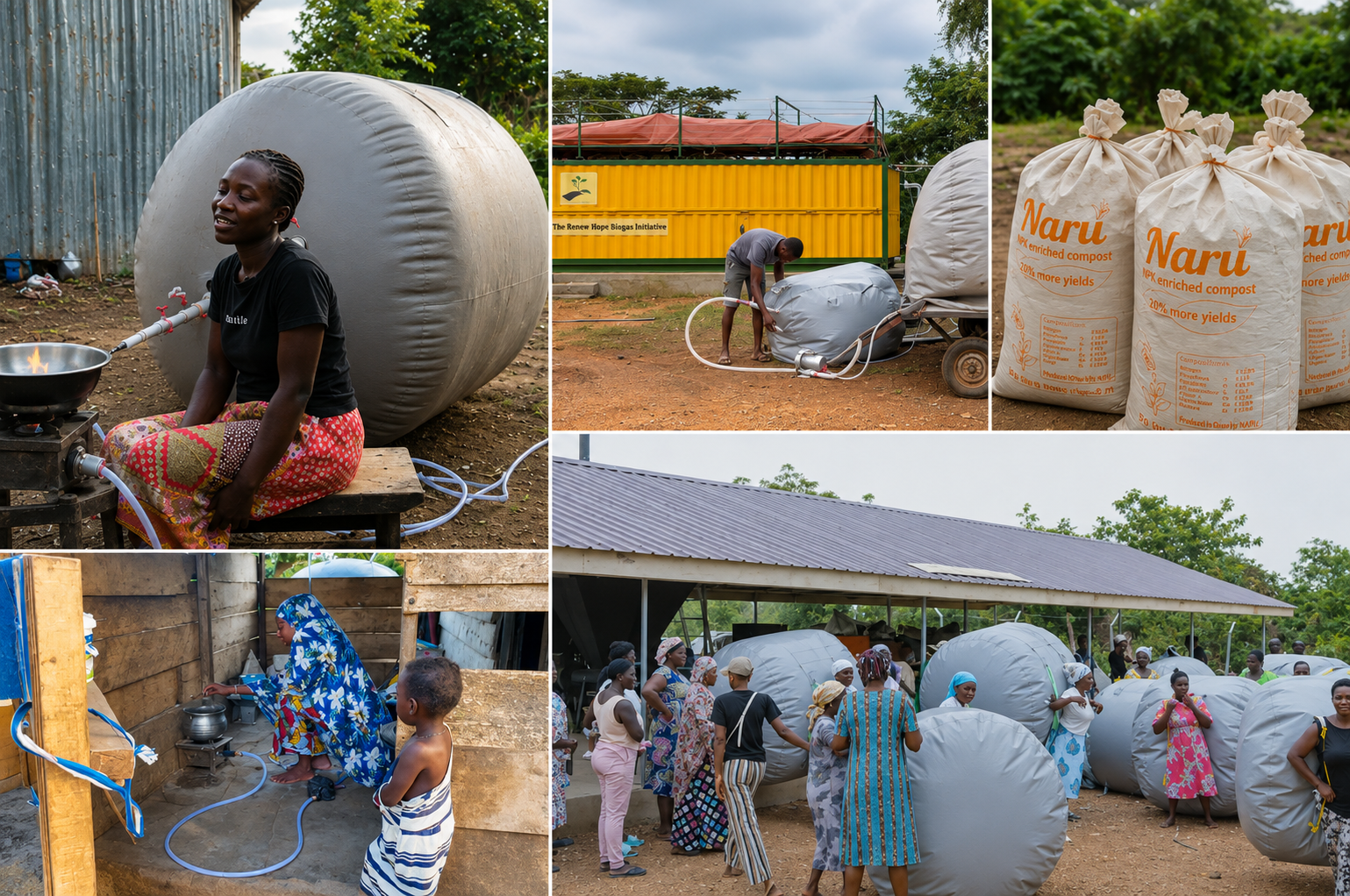
Our answer is a decentralised energy model built around community-scale biodigesters. Organic waste goes in. Cooking gas and nutrient-rich digestate come out. Local operation connects the two.
A household digester puts the entire operating burden on one household. Feedstock has to be available consistently. The system has to be fed correctly, maintained and repaired when something goes wrong.
We chose to organise these functions at community level instead. Feedstock can be collected and managed collectively, while trained operators take responsibility for running the system. Gas can then serve multiple households from one operating point.
This does not make the technical problem disappear. It changes who is responsible for solving it.
That distinction matters. A biodigester that produces gas during a demonstration is not yet useful energy infrastructure. It becomes useful only when somebody is accountable for tomorrow’s feedstock, maintenance and gas supply.
A community biogas system needs someone to run it every day. Feedstock has to arrive. Equipment has to be maintained. Gas has to reach households reliably.
Under RenewHope, the intention is to organise each system around local management of feedstock, operations, maintenance and cooking-gas distribution.
We deliberately separate this operating model from grant funding or carbon-credit sales. The cooking service has to solve a real household energy problem first. Carbon finance can support the system, but it cannot substitute for a system people use and operators can maintain.
That is the difference between installing equipment and building decentralised energy infrastructure.
The circular model starts with material that already exists locally. Organic agricultural residues and other suitable biomass become feedstock for anaerobic digestion rather than being treated only as waste.
Inside the biodigester, microorganisms break down that organic material without oxygen. The process produces biogas for cooking and leaves a nutrient-rich digestate that can be processed for agricultural use.
The loop is straightforward:
organic waste → biogas → cooking gas
organic waste → digestate → agricultural input → farm
This is where our work on circular agriculture and decentralised energy meet. The same material stream can address waste management, cooking energy and soil inputs instead of treating each as a separate project.
A climate project can reduce emissions and still make little sense to the farmer expected to participate in it.
Our starting point is different. The agricultural system has to create practical value on the ground. That can come from creating a productive use for farm residues, improving access to organic soil inputs, or creating local operating work.
We therefore treat carbon as an outcome of a functioning agricultural and energy system, not as the reason the system exists.
That principle also changes project design. If a carbon methodology rewards an activity that is difficult for farmers to maintain, the answer is not to push harder for adoption. The operating model needs to change.
Carbon finance can help fund the transition from polluting cooking fuels to lower-emission alternatives and support the monitoring needed to quantify climate outcomes. RenewHope is being developed with an Article 6.2 pathway in view.
Article 6.2 of the Paris Agreement provides accounting and reporting rules for countries cooperating through internationally transferred mitigation outcomes. Ghana has established its own framework covering eligibility, authorisation, tracking and reporting for activities seeking to participate in this system.
For us, carbon finance is therefore a financing layer around the underlying business. The physical system still has to collect waste, produce usable gas and deliver a service people want.
Centralising operations solves some problems and concentrates others.
If a community system stops operating, the disruption affects more than one household. Feedstock shortages, poor operating discipline, equipment faults or delayed maintenance can interrupt gas production. A larger digester is not automatically a more reliable digester.
That is the uncomfortable part of the model. Scale increases the value of good operations, but it also increases the consequences of bad operations.
We therefore have to treat operator training, feedstock planning, maintenance records and performance monitoring as part of the infrastructure itself. The digester is only one component.
Start with the operating system, not the carbon credit.
Before scaling community biogas, prove that feedstock can arrive consistently, operators can keep the equipment running and households actually use the gas. Then measure the climate outcome.
That sequence is slower than treating installation as success. It is also much closer to what it takes to build an energy business that lasts.
Keep reading
1 September 2026 · Clean Energy
Read
3 July 2026 · Clean Energy
Read
5 August 2026 · Carbon Removal
Read